
MESSAGE FROM THE GROUP SUSTAINABILITY COMMITTEE CO-CHAIRS
2025 was a year of extraordinary challenges, shaped by geopolitical instability, tariff tensions and record-breaking weather events that affected communities and economies across the world. Yet it also offered signs of progress, including renewable energy surpassing coal as the world’s leading source of electricity in the first half of 2025, according to Ember. In such an environment, the importance of resilient, responsible and forward-looking leadership has become ever more evident.
At Hutchison Ports, sustainability is integral to the way we strengthen our operations, support our people and communities, and create enduring value across our global network. In 2025, we made meaningful progress in advancing our climate ambitions, reinforcing operational resilience, and accelerating the transition towards a safer, more inclusive, digital and lower-carbon future. Our conviction remains clear: long-term performance depends on navigating a rapidly changing environment with discipline, responsibility and fidelity to our values.
Safety remains a defining priority across our business. Supported by our Safety Management System and governance oversight through Group Safety Committee (SAFCOM), we introduced new initiatives during the year, including the Governance of Electrification Policy and enhanced Radiation Safety Guidance to address emerging risks. We also expanded AI-enabled Yard Surveillance Systems and advanced automation technologies such as ATs to reduce exposure to higher-risk activities.
As digital technologies become more deeply embedded across our operations, we remain focused on deploying innovation responsibly. We apply AI and automation in ways that enhance safety, transparency and operational efficiency, while maintaining appropriate human oversight and giving due consideration to data privacy, ethics and workforce impacts.
As digitalisation deepened across our terminals and operations, cyber security remained a critical business priority. During the year, we strengthened our framework through enhanced monitoring, employee awareness programmes, infrastructure resilience and risk management processes designed to safeguard operational continuity, sensitive data and critical systems.
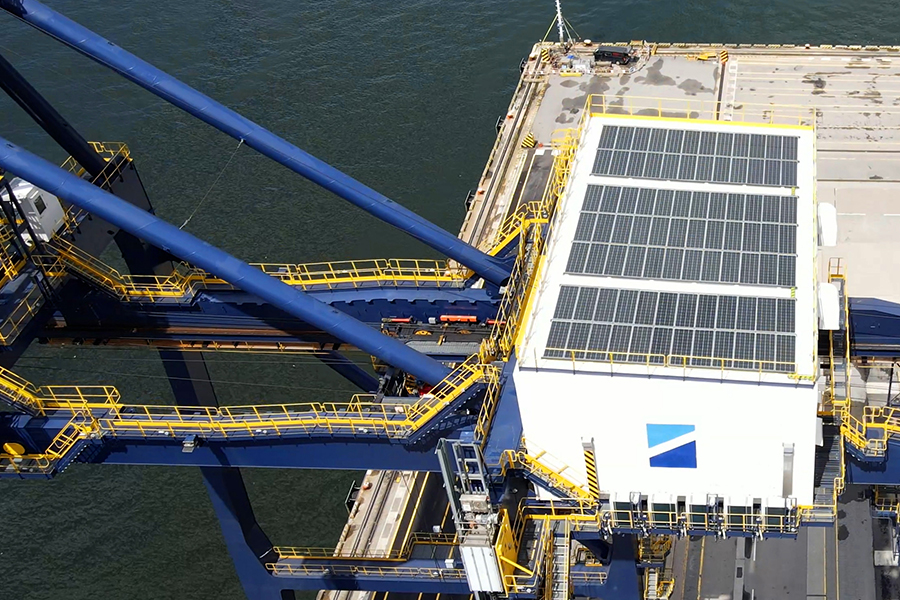
Our decarbonisation journey gathered further momentum in 2025, with a 23.9 per cent reduction in combined scope 1 and scope 2 emissions against our 2021 baseline. Carbon intensity improved to 9.66 kg CO2e per TEU, while renewable electricity accounted for approximately 45 per cent of total electricity consumption. These results reflect sustained effort across operational efficiency, electrification and renewable energy adoption, and keep us aligned with our Science Based Targets initiative (SBTi)-validated targets, reinforcing our commitment to achieving our 2023 reduction goals and net-zero ambition for 2050.
We also embedded circular economy principles across our operations and supply chain through sustainable procurement, electrification initiatives and optimised spare parts management. Supplier engagement workshops were launched to support decarbonisation efforts related to scope 3 emissions.
This broader focus on the value chain also underscores the importance of responsible procurement. We encouraged suppliers to align with our expectations on environmental performance, ethical business conduct, labour standards and human rights principles, strengthening transparency and resilience across our procurement activities.
Respect for labour and human rights remains fundamental to our business and culture. We are committed to providing a safe, inclusive and respectful working environment free from discrimination, harassment, forced labour and child labour, supported by policies and governance processes that promote fair treatment and equal opportunity.
Our people remain central to our long-term success, and in 2025 we invested in employee well-being, engagement and leadership development to build a resilient and future-ready workforce. The BEWELL programme expanded its focus on physical, mental and emotional well-being, while more than 1,400 employees participated in Global Connect under the theme “Empower to Elevate”. We also recognise gender balance as a structural challenge within the port sector, with greater scope to address this over time through remote-controlled equipment and evolving operating models.
Strong ethical standards remain essential to maintaining stakeholder trust and long-term business resilience. Our commitment to ethics, anti-bribery and anti-corruption is supported by clear policies, employee training, governance oversight and compliance mechanisms that promote integrity, accountability and responsible decision-making across the organisation.
We also created positive social impact in the communities where we operate. Building on the success of our Go Green & Dock School initiative, we launched “Go Beyond Go Green” as a group-wide platform for environmental engagement and education. The programme delivered a 21 per cent increase in activities during the year, with more than 8,000 trees planted and over 4,400 students engaged globally.
Protecting biodiversity and supporting healthy ecosystems remain important elements of our environmental approach. Through tree planting, awareness programmes and responsible operational practices, we supported biodiversity protection and encouraged greater environmental stewardship across our sites and local communities.
Digitalisation and automation remain important enablers of our future operating model. During the year, we advanced the rollout of ATs across multiple terminals, with 59 units deployed across BUs in Egypt, Mexico, Thailand, United Kingdom. Our Terminal Operating System, Veronica, also evolved as a strategic platform supporting Operations 5.0 and enabling greater standardisation, shared services and data-driven decision-making across the network.
To support this transformation, we strengthened our sustainability governance and reporting structure in preparation for evolving regulatory expectations, including Corporate Sustainability Reporting Directive (CSRD) and EU Taxonomy readiness. Sustainability oversight remains led by the Group Sustainability Committee, with ESG considerations embedded into enterprise risk management and strategic decision-making. Sustainability performance is also integrated into leadership evaluation and incentive structures, reinforcing accountability across the organisation.
Looking ahead, we remain focused on delivering credible decarbonisation outcomes while maintaining operational resilience and responsible growth. As electrification, automation and digitalisation scale across our network, we will prioritise the safe management of emerging risks, strengthen ESG governance, advance responsible technology practices, and invest in our people and communities.
We invite you to explore this report and the progress we made in 2025, which we are proud of. Building a more sustainable and inclusive business requires collective effort, and we are grateful to our customers, partners and employees for their support. Together, we have taken important steps towards a more sustainable future for our people, our customers and the communities we serve.
Together we can make it happen!
Managing Director
Europe
Managing Director
South East Asia & Australia
Co-chairs, Group Sustainability Committee